
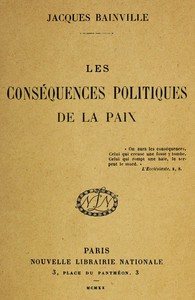
Les conséquences politiques de la paix by Jacques Bainville
Published in 1920, Jacques Bainville's Les conséquences politiques de la paix is a book that reads like a prophecy. Written just after the Treaty of Versailles was signed, it doesn't just describe the peace terms; it tries to predict what they will actually do to Europe.
The Story
There's no traditional plot with characters. Instead, the 'story' is the future of Europe itself. Bainville walks through the treaty's major decisions. He looks at the harsh punishments for Germany, the creation of new, fragile countries in Eastern Europe, and the redrawing of borders that left millions of people feeling wronged. His argument is simple: this treaty doesn't create a lasting peace. It creates a powder keg. He explains that by humiliating and economically crippling Germany, the Allies have guaranteed a future desire for revenge. By building new nations with mixed populations, they've planted the seeds for future ethnic conflict. He traces the likely political and military chain reactions, country by country, with a clear and logical style that's surprisingly easy to follow.
Why You Should Read It
What blew me away was Bainville's cold, clear-eyed logic. He isn't emotional. He's just connecting dots on a map. When he points at a new border and says, 'This will be a problem in ten years,' you can see it. Reading this in the 21st century is a haunting experience because we know he was right. His predictions about German resentment, the instability of Eastern Europe, and the inevitable collapse of the post-war order came true with terrifying accuracy. It makes you think hard about how short-term political victories can lead to long-term disasters. This book isn't about blaming individuals; it's about understanding the unintended consequences of political decisions.
Final Verdict
This is a must-read for anyone interested in 20th-century history, international relations, or just brilliant political analysis. It's perfect for history buffs who want to understand the 'why' behind World War II, not just the 'what.' It's also great for readers who enjoy seeing a sharp mind at work, dissecting a complex problem. While it's a serious work, Bainville's writing is direct and avoids academic jargon. You don't need a PhD to get it. Just be prepared for a book that will make you look at peace treaties—and the news—in a whole new, more cautious light.
You are viewing a work that belongs to the global public domain. It is now common property for all to enjoy.
Linda Thompson
9 months agoBeautifully written.






Deborah Gonzalez
3 weeks agoAs someone who reads a lot, the pacing is just right, keeping you engaged. A valuable addition to my collection.