
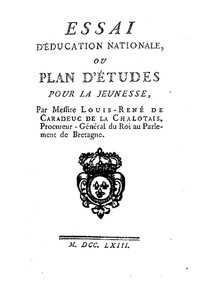
Essai d'éducation nationale, ou, plan d'études pour la jeunesse by La Chalotais
Let's set the scene. France, mid-1700s. If you wanted a formal education, you likely got it from the Jesuits, a Catholic religious order. Enter Louis-René de Caradeuc de La Chalotais, a prominent public official in Brittany. Fresh off his role in the legal expulsion of the Jesuits from France, he writes this 'Essay on National Education' in 1763. It's less a story with characters and more a direct, forceful proposal.
The Story
There's no plot twist, but there is a huge argument. La Chalotais lays out a detailed plan for a complete overhaul of French schooling. His core idea is simple but revolutionary for its time: education is a public duty, not a religious one. He argues that the state, not the Church, should design the curriculum, train the teachers, and run the schools. He wants to create loyal, useful citizens for the kingdom, teaching practical subjects, history, law, and the sciences. He's openly critical of the Jesuit methods, suggesting they produce people who are more devoted to Rome than to France. The essay is his blueprint for a system that serves the nation first.
Why You Should Read It
This book is a foundational text. It's incredible to see ideas we now take for granted—like secular public education—being fought for so clearly 260 years ago. La Chalotais writes with the passion of someone who knows he's challenging a massive institution. You can feel his frustration with the status quo and his burning belief that a country's future depends on how it teaches its kids. It’s not an easy beach read; the language is formal and the concepts are dense. But the central conflict—who controls the knowledge given to the next generation—feels incredibly modern. It makes you realize that debates about school curriculums today are part of a very old conversation.
Final Verdict
This one's for the intellectually curious, not the casual fiction fan. It's perfect for history buffs, educators, or anyone interested in the roots of our modern public school systems. If you've ever wondered where the idea of 'secular education' came from, this is a primary source staring you right in the face. It’s a short, potent dose of Enlightenment thinking that shows how radical the idea of a national, state-run school system once was. Be prepared for a challenging but rewarding look into the mind of a reformer who helped change the world's classroom.
This historical work is free of copyright protections. Knowledge should be free and accessible.
Michelle Thompson
6 months agoSimply put, the content flows smoothly from one chapter to the next. I would gladly recommend this title.
Sandra Sanchez
1 year agoBeautifully written.
Oliver Johnson
6 months agoGreat reference material for my coursework.


Kimberly Torres
1 year agoHelped me clear up some confusion on the topic.